
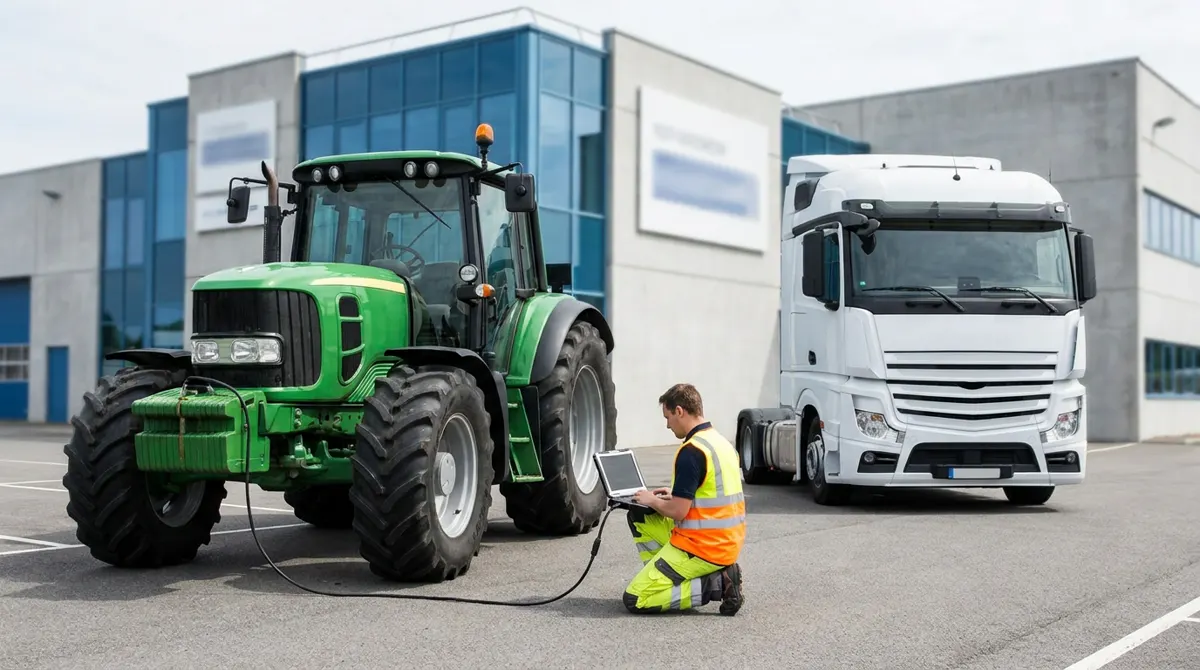
In short: J1939 support is coming soon. Ecuhawk already handles 29-bit CAN IDs, DBC decoding, trace, graphs, logging, panels, bench control and test automation, which a J1939 bench also needs. The J1939 features below complete it, shaped with beta members.
What works today on a J1939 bus
- Trace, filters, graphs and logging of 29-bit extended frames.
- DBC decoding of known message IDs.
- Power supply, relay and load control for the bench.
- Test steps, panels, operator mode and reports.
What J1939 support adds
- PGN-based decoding that works for any source address.
- Transport protocol (BAM and connection mode) for long messages.
- DM1 active faults and DM2 previous faults, with SPN and FMI shown in plain text.
- Address claim and request PGN.
- J1939 test steps: wait for a PGN, check an SPN, expect or clear a fault.
Who this is for
Engine, transmission and body ECU suppliers for commercial vehicles, tractor and farm equipment makers, construction and mining machinery, gensets and marine engines.
Questions
Does Ecuhawk support J1939?
J1939-specific features are planned. Today Ecuhawk handles 29-bit CAN frames with DBC decoding, logging, bench control and tests, which already covers much of a J1939 bench.
Will Ecuhawk read DM1 fault codes?
Yes, DM1 and DM2 with SPN and FMI decoding are part of the J1939 plan.
How can I get J1939 support sooner?
Join the beta and choose J1939 in the form. Features with the most requests are built first, and design partners can test early builds.